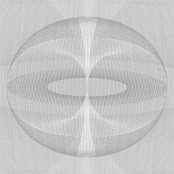








 This Project has an inherent visual language system. It emerged from the Project's dynamic formal structure—or tree—shown to the left. For more about the tree, see A.
The basic elements of the Project's visual language system—especially with regard to how shapes and colors are used—are as follows.
Shapes are used diagrammatically and symbolically and can take on different meanings when colored. Below are what the shapes signify without color.
| symbol | description | referent |
 |
center-line axis | experiencer-experiencing-experienced |
 |
cone pointing down/ opening up | experiencer, being-thrown-under |
 |
torus | experiencing, being-thrown-back-and-forth (dialogue, reciprocity, hermeneutic circle) |
 |
cone pointing up/ opening down | experienced, being-thrown-before (in front of, in the way of) |
 |
egg from arcs of unfolding tree | openness to/ horizon of intelligibility |
 |
vesica from intersecting spheres | discursive disclosing of intelligibility |
 |
cone pointing right/ opening left | subjective |
 |
cone pointing left/ opening right | objective |
 |
sphere; cone opening away (centered) | experiencing, attending; active |
 |
l'arbre de rien (tree) | actual (self/world) engagement; meaning-making |
 |
disk/horizontal plane (edge view) | meaningfulness |
 |
disk in network (top view) | particular dimension of meaningfulness |
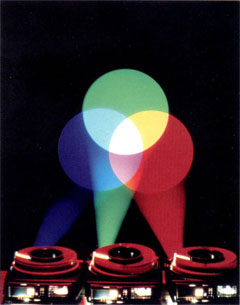
The colors used by this Project are the colors of light, having additive color properties such that white light contains the spectrum. The colors are meant to be analogous to the way conceptual forms in this Project cancel each other out relationally.
 |
colors | primary referents | select additional associations | Maslow's needs | |
| white | (all) | unhidden, revealed, disclosed | |||
| magenta | self+world | psychological+physiological | non-duality, flow, transition between levels; skill | transcendence | |
| blue | self | psychological | autonomy, self-control, authenticity, will, character; focus | self-actualization | |
| cyan | dynamic+self | sociological+psychological | recognition, empathy; acquaintance | esteem | |
| green | dynamic | sociological | community, reciprocity, sharing, making common; rhythm | love/belonging | |
| yellow | world+dynamic | physiological+sociological | security, stability, reliability; assertion | safety/security | |
| red | world | physiological | vitality, physicality; holism | physiological | |
| black | (none) | hidden, concealed, closed off | |||
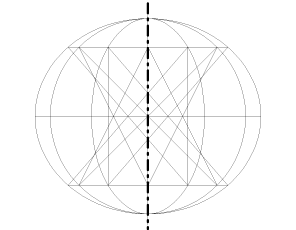 The basic symbol for the Project's I-phase is a vertical axis. The axis, with its three nodes, represents the unity of the three terms about which the Project revolves: experiencer-experiencing-experienced. The axis isn't substantial. It's not as if there's a solid axel at the center of the system. This is why the axis is represented by a center line and not a line segment. There's nothing (substantial) there. The center line axis merely indicates the presence of a point of zero dimension where experiencer-experiencing-experienced collapse into experience as such (experience of nothing in particular). Said another way, the axis doesn't represent a particular ideology or set of beliefs that Project participants must accept; the system is non-ideological. The axis indicates the presence of open-ended questions.
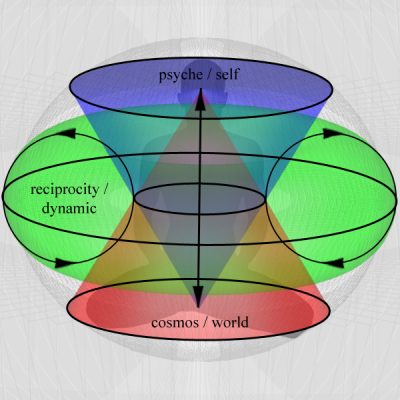
 Another way to conceive of the axis is in terms of directionality, as an arrow or arrows. As applied to the A-phase, for example, the axis is an arrow indicating purposive activity, pointing from the past (beneath/below) to the future (before/above). It represents the directionality of living life. As functioning in the I-phase, there are two superimposed arrows (⥮). Self and world are not dichotomous. They're not polar opposites, pointing away from each other. They point in opposite directions—not away from each other or toward one another—but as superimposed, interpenetrating by equal measure, representing their complete interdependence.
This interpenetration can be seen in the image to the right: the vertically-oriented blue and red cones that represent experiencer/self and experienced/world interpenetrate. The green torus indicates their dynamic relationship.
As a phase-level part of the Project, the axis contains the J, W, and K nodes.
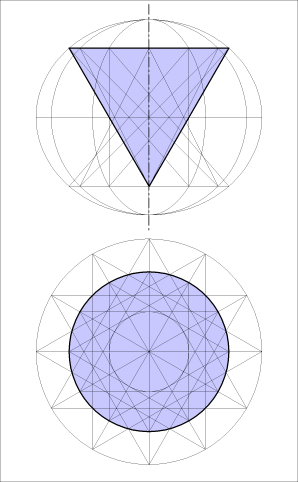
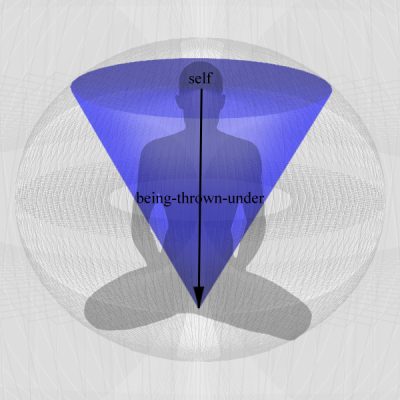 As part of the experiencer-experiencing-experienced axis, the J-node is properly just experiencer as such, but as we are already involved in a discursive space of meaning involving particular experiencers experiencing experienced particulars, we paradigmatically understand experiencer as such in terms of experiencer as self, hence the blue color. (The cone pointing down = experiencer, and the blue color = self.)
As it applies to the J-node, the cone pointing down signifies being-thrown-under. The experiencer is being-thrown-under the experienced just as the experienced is being-thrown-before the experiencer. Speaking in purely formal terms, experiencer is subjected to the pressures of that which is experienced. To sub-ject is to thrown under (from [L] sub "under" + combining form of iacere "to throw"). It's the unifying point of view that is being-thrown-under that which is experienced, feeling the plurality if its pressures as an unified experience, allowing this point of view to stand in the midst of (understand) them.
The diagrammatic components of the J-node cone include its circular base (at the top), its apex (at the bottom), and the line-segments stretching between its base and apex, as centered around its axis. These parts correspond to experiencer as world (base), experiencer as self (apex), and experiencer as dynamic (axis-centered segments). As world, experiencer is a common point of view, intersubjectively shared by all memebers of a world. As self, experiencer is an unique point of view, positioned unlike any other. As dynamic, experiencer is a durational point of view, always in the process of transforming. The transformation could involve the process of moving between the common point of view and one's unique point of view, it could mean the empathic process of adopting (as much as is possible) the unique points of view of others, or it could simply mean the process of keeping track of what-it's-like to be subjected to the ongoing pressures of that which is experienced.
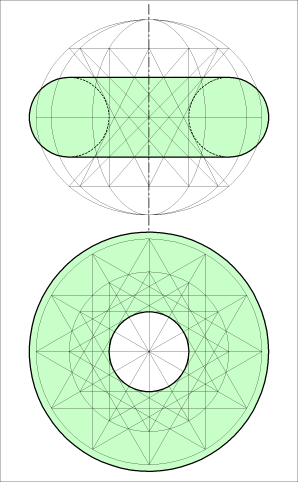
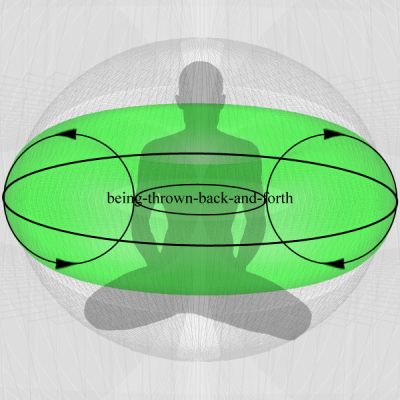 As part of the experiencer-experiencing-experienced axis, the W-node is properly just experiencing as such, but as we are already involved in a discursive space of meaning involving particular experiencers experiencing experienced particulars, we paradigmatically understand experiencing as such in terms of experiencing as (self/world) dynamic, hence the green color. (The torus = experiencing, and the green color = dynamic.)
This self/world dynamic is the discursive activity of meaning-making. It's dialogical in nature, indicating an interdependent, reciprocal relationship between self and world—a process of being thrown back-and-forth between self and world. This dialogue makes meaning by opening a discursive space in which intelligibility occurs. This discursive, dialogical activity counts as the process of interpreting reality meaningfully. It's an hermeneutic process—a dialogue between part and whole, text and context—where self is paradigmatically the part and world is paradigmatically the whole.
The diagrammatic components of the W-node torus include its inner horizon (the donut hole), its outer horizon, and the vertically-oriented loop that forms the body of the donut as it rings the axis. These parts correspond to experiencing as self (inner horizon donut hole), where the dynamic moves toward parts, experiencing as world (outer horizon), where the dynamic moves toward wholes, and experiencing as dynamic (vertically-oriented loop), where the dynamic moves dialogically, actively integrating self and world, part and whole.
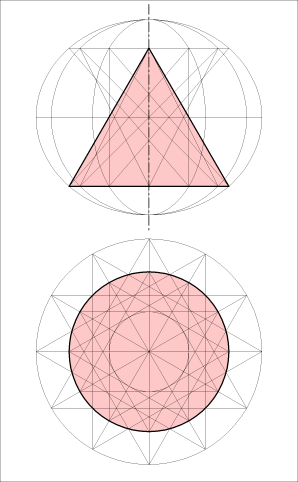
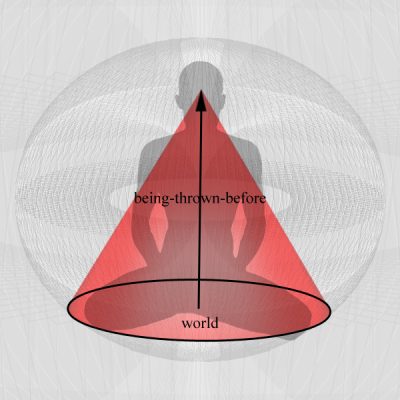 As part of the experiencer-experiencing-experienced axis, the K-node is properly just experienced as such, but as we are already involved in a discursive space of meaning involving particular experiencers experiencing experienced particulars, we paradigmatically understand experienced as such in terms of experienced as world, hence the red color. (The cone pointing up = experienced, and the red color = world.)
As it applies to the K-node, the cone pointing up signifies being-thrown-before. The experienced is being-thrown-before the experiencer just as the experiencer is being-thrown-under the experienced. Speaking in purely formal terms, experienced is paradigmatically a domain of significance—i.e., a world as an holistic object of attention. To ob-ject is to throw in the way of (from [L] ob "in front of, towards, against" + combining form of iacere "to throw"). It's that which shows up as intelligible/meaningful to an experiencer.
The diagrammatic components of the K-node cone include its circular base, its apex, and the line-segments stretching between its base and apex, as centered around its axis. These parts correspond to experienced as world (base), experienced as self (apex), and experienced as dynamic (axis-centered segments). As world, experienced is a (whole) system of significance, or, to quote Richard Polt, "a system of purposes and meanings that organizes our activities and our identity, and within which entities can make sense to us" (from Heidegger, an Introduction [Cornell UP 1999] pg. 54); it's presented as significance. As self, experienced is that which uniquely appears before a particular individual, toward the purely qualitative what-it's-like-ness of particular appearances/presentations. As dynamic, experienced may mean the durational facts, events, and states of affairs presented to anyone of a given world, or it may mean the process whereby one's own qualitative experiences are reconciled with the system of significance. This existential hermeneutical process is most often carried out pre-reflectively, but it can become consciously explicit as the process is presented linguistically, reifying its parts in propositions.
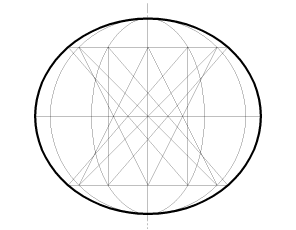 The tree unfolds along these arcs, tracing a volume. This may be thought of as a temporal space of intelligibility—a stretched out present (stretching into the past below and future above).
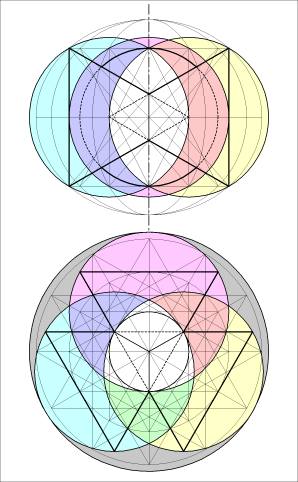
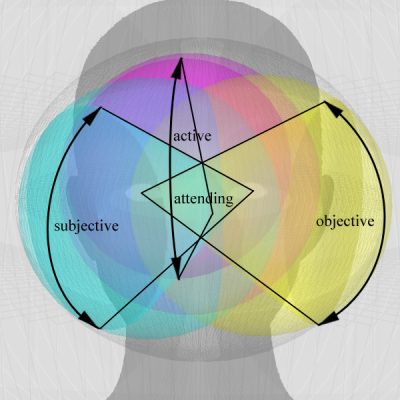 Each node in the O-phase combines a mode of experiencing/attending with a relationship between experiencer and experienced. The modes of experiencing/attending disclose different relationships between experiencer and experienced. The relationships plus the mode of attending constitute different modes of intelligibility—namely, subjectivity, activity, and objectivity. Together, the discursive activity of running between subjective, active, and objective attending opens within reality a domain of intelligibility, disclosing reality as meaningful/experiential. This intelligible realm is represented by the egg symbol/diagram, and the vesica formed at the intersection of overlapping spheres represents how this disclosure relies on the overlapping of different modes of intelligibility. The modes of intelligibility aren't mutually exclusive but are always mixed together even as they tend toward different types of experience and knowledge.
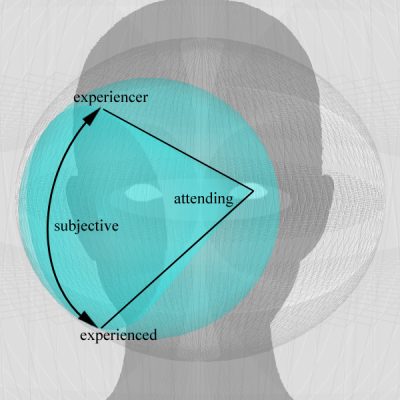 The M-node symbol combines a cone opening left (subjective) with a sphere (attending) and the color cyan (representing that toward which the subjective mode of attending is stretching—namely, the acquaintance knowledge accompanying qualitative experience).
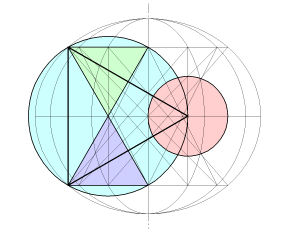 The symbol involves the conjunction of three elements (pictured to the left): a fluid/dynamic point of view (the green cone pointing down), an expansive/receptive mode of attending (the red sphere), and one's own qualitative states as the object of attention (the blue cone pointing up). When the distance between the fluid point of view (green cone) and one's own qualitative states (blue cone) is reduced to zero—the immediacy of an identity—acquaintance knowledge occurs. This identity is achieved to the same degree that the mode of attention is broad in its openness/receptivity.
Insofar as qualitative experience occurs immediately—that is, unmediated by beliefs or conceptual distance—the distance between experiencer and experienced tends to shrink toward an identity. Since, diagrammatically, experiencer and experienced fall along the circumference of the subjectivity cone's base, separated by the base's diameter, the cone's base tends to collapse toward becoming a flattened line segment. When it does this, the cone becomes a triangle separating the experiencer/experienced identity, represented by one side of the triangle, from experiencing (in this case, the holistic mode of attending), represented by the opposite vertex. If the vertical dimension represents time/duration, we see that the subjective mode of attending tends toward the ever-flowing/fluctuating present. The cone of subjectivity tends to collapse toward the immediacy of present experience. We also see that the distance between the experiencer/experienced identity and the mode of experiencing is preserved. With reference to the torus, experiencing occurs along the torus's inner horizon (the donut hole) while the experiencer/experienced identity occurs along the torus's outer horizon (its horizontal limit) where the two horizons are at their greatest distance apart. This symbolizes the holistic nature of the attending. The experiencer/experienced identity is fully immersed in the fullness of its contextuality upon the plane of presence.
Another way to look at the M-node symbol is as follows: it combines a cone opening left with a cyan sphere, where both the cone opening left and the cyan sphere diagrammatically combine a mode of experiencing on the one hand with a relationship between experiencer and experienced on the other. In the case of the cone opening left, its apex represents the mode of experiencing (red sphere), while its base represents the relationship between experiencer (green cone) and experienced (blue cone). The colors cancel to white. In the case of the cyan sphere, it takes the shape of experiencing (sphere) and the color of the relationship between experiencer and experienced (green+blue).
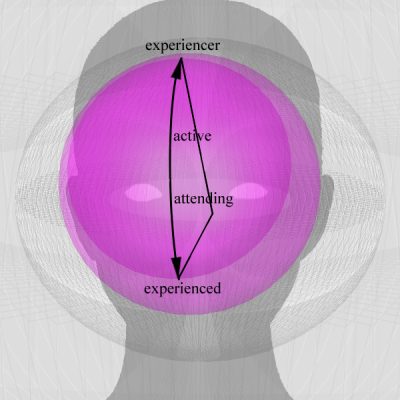 The N-node symbol combines a cone opening away, as centered (active), with a sphere (attending) and the color magenta (representing that toward which the active mode of attending is stretching—namely, the skillful knowledge accompanying the flow states of practical experience).
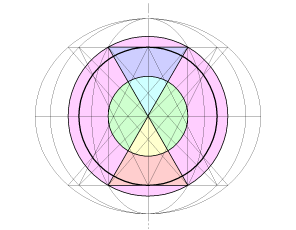 The symbol invovles the conjunction of three elements (pictured to the left): a particular point of view, or agent (the blue cone pointing down), a rhythmic mode of attending (the green sphere), and the significance of an arena as the object of attention (the red cone pointing up). When the distance between agent (blue cone) and arena (red cone) resonates with the scope of rhythmic attention (green sphere)—that is, when an active flow state is achieved—skillful knowledge is exhibited.
Another way to look at the N-node symbol is as follows: it combines a cone opening away (centered) with a magenta sphere, where both the cone and the magenta sphere diagrammatically combine a mode of experiencing on the one hand with a relationship between experiencer and experienced on the other. In the case of the cone, its apex represents the mode of experiencing (green sphere), while its base represents the relationship between experiencer (blue cone) and experienced (red cone). The colors cancel to white. In the case of the magenta sphere, it takes the shape of experiencing (sphere) and the color of the relationship between experiencer and experienced (blue+red).
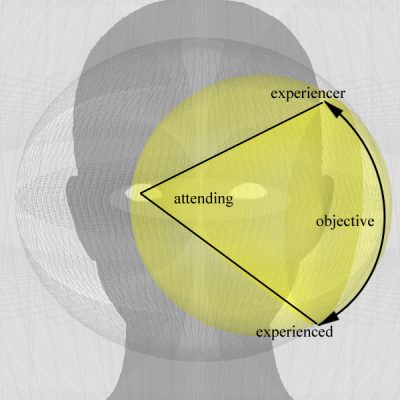 The P-node symbol combines a cone opening right (objective) with a sphere (attending) and the color yellow (representing that toward which the objective mode of attending is stretching—namely, the propositional knowledge accompanying impartially observed experience).
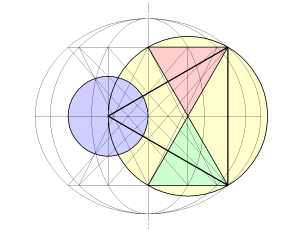 The symbol invovles the conjunction of three elements (pictured to the left): an universal point of view (the red cone pointing down), a focusing mode of attending (the blue sphere), and facts, events, and states of affairs as the object of attention (the green cone pointing up). When the distance between the universal point of view (red cone) and the facts (green cone) is maximized—the impartial distance of objectivity—propositional knowledge may occur. This maximal distance is achieved to the same degree that the mode of attention is focused/narrowed on the details of the facts being attended to, irrespective of the wider context in which those details occur.
Said another way, the P-node symbol combines a cone opening right with a yellow sphere, where both the cone opening right and the yellow sphere diagrammatically combine a mode of experiencing on the one hand with a relationship between experiencer and experienced on the other. In the case of the cone opening right, its apex represents the mode of experiencing (blue sphere), while its base represents the relationship between experiencer (red cone) and experienced (green cone). The colors cancel to white. In the case of the yellow sphere, it takes the shape of experiencing (sphere) and the color of the relationship between experiencer and experienced (red+green).
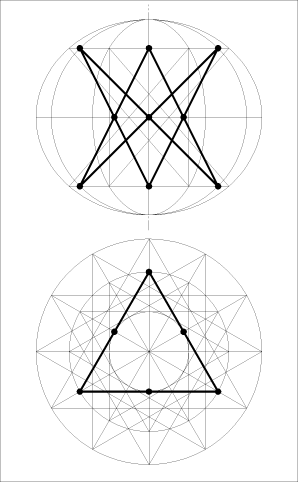
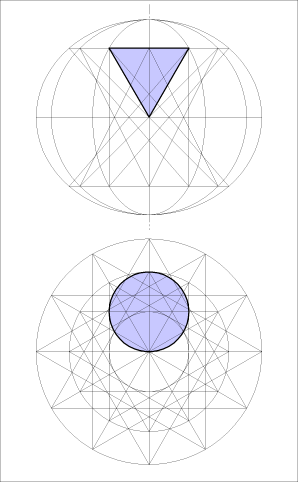
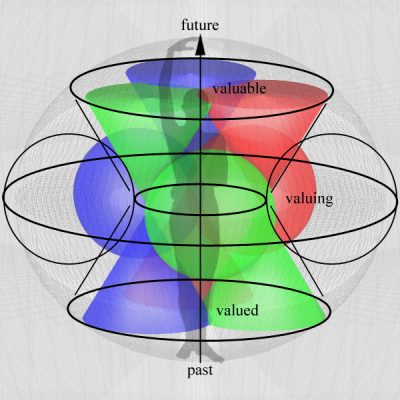 This is the original diagram/symbol that gave rise to all the others. It's called l'arbre de rien, or tree for short. When experiencer/self, experiencing/dynamic, and experienced/world integrate to leave only experience as such, each is understood in its own terms and in terms of the others. This forms nine terms. L'arbre de rien (the tree) connects those nine terms in a continuous, six-segmented line that can fold up into an axis or unfold into a triangle. As folded up, the A-phase tree shifts to the I-phase. As unfolded it shifts to the L-phase. And the arcs scribed by its folding up and its unfolding represent the O-phase.
L'arbre de rien is also the symbol out of which the central torus image arose. When rotated about its vertical axis (which is itself formed by the tree as folded up), the tree scribes an inner circle and two larger circles—one above and one below the smaller inner circle. These circles are analogous to top and bottom of the torus hole. Moreover, when the unfolded tree (the horizontal triangle) rotates around the same axis, an outer circle is formed at the horizon. This completes the torus.
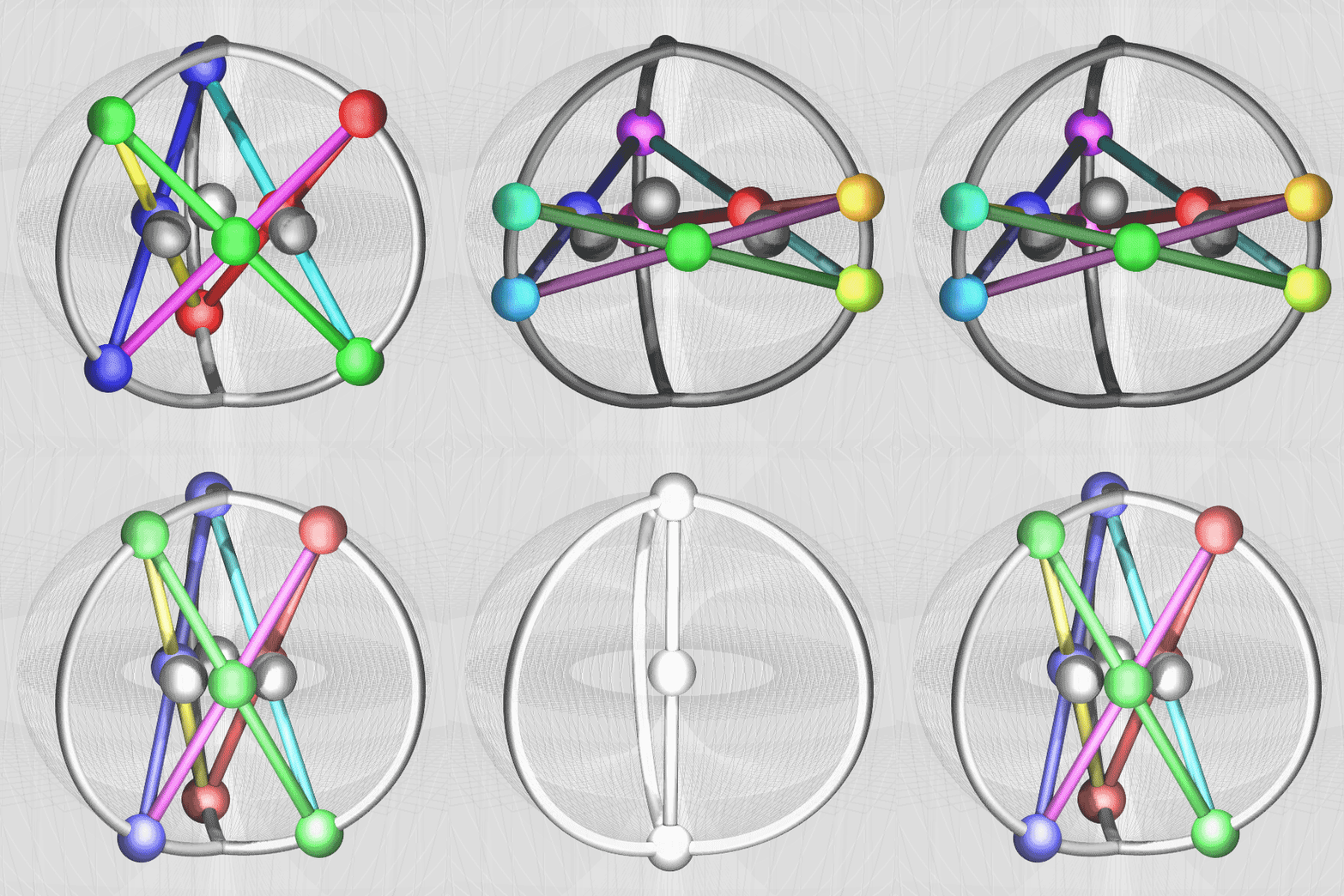
In the 3D figure on the right, six cones and three spheres symbolically represent the nine nodes as they're arranged on the A-phase tree.
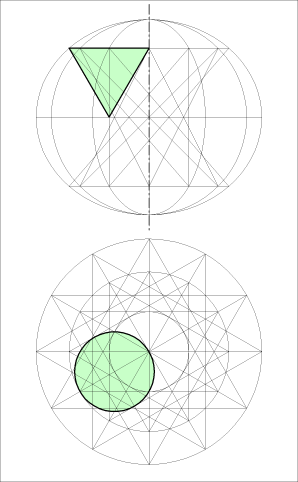
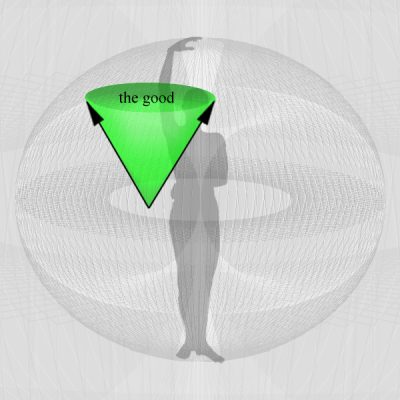 Following the representational logic of the I-phase, the T-node symbol combines a cone pointing down (experiencer) with the color green (dynamic), indicating experiencer as dynamic.
When applied to the A-phase dealing with value, the logic of T gets interpreted according to actual, practical (self/world) engagement over time, with the past below, the future above, and the present stretched out before us. Since we understand who we are in terms of the possibilities we project for ourselves, the cones pointing down (T, S, and Y) get reinterpreted as cones opening up. Their apexes are in the present, and they're opening up to the possibilities we project for ourselves into the future. These are our "oughts." We ought to engage in our world in a certain way because we ought to be a certain way that we aren't already. That which allows us to become who we are—to become our own (a futural notion)—is valuable. Modes of engagement are valuable insofar as they help us realize our possibilities of becoming who we truly are. So the cones are not so much a being-thrown-under as they are in the J-node, or points of view as they are in the O-phase; here they are being-thrown-forth, pro-jecting possibilities.
The cone opening up thus means valuable, and together with the color green, the T-node symbol means valuable (for itself). In other words, the T-node symbol represents that which is good (in itself).
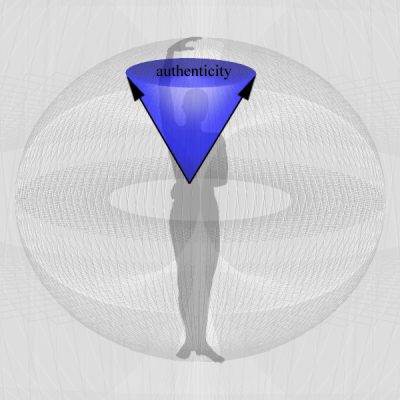 Following the representational logic of the I-phase, the S-node symbol combines a cone pointing down (experiencer) with the color blue (self), indicating experiencer as self.
When applied to the A-phase dealing with value, the logic of S gets interpreted according to actual, practical (self/world) engagement over time, with the past below, the future above, and the present stretched out before us. Since we understand who we are in terms of the possibilities we project for ourselves, the cones pointing down (T, S, and Y) get reinterpreted as cones opening up. Their apexes are in the present, and they're opening up to the possibilities we project for ourselves into the future. These are our "oughts." We ought to engage in our world in a certain way because we ought to be a certain way that we aren't already. That which allows us to become who we are—to become our own (a futural notion)—is valuable. Modes of engagement are valuable insofar as they help us realize our possibilities of becoming who we truly are. So the cones are not so much a being-thrown-under as they are in the J-node, or points of view as they are in the O-phase; here they are being-thrown-forth, pro-jecting possibilities.
The cone opening up thus means valuable, and together with the color blue, the S-node symbol means valuable for self. In other words, the S-node symbol represents that which is good for me.
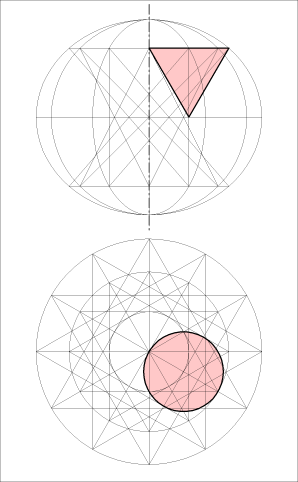
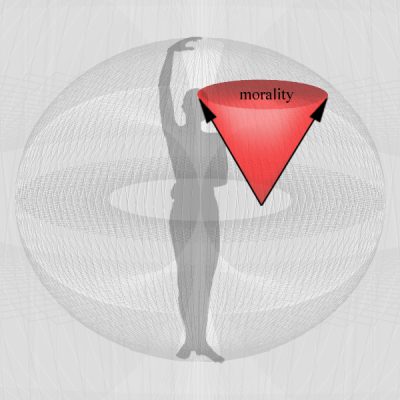 Following the representational logic of the I-phase, the Y-node symbol combines a cone pointing down (experiencer) with the color red (world), indicating experiencer as world.
When applied to the A-phase dealing with value, the logic of S gets interpreted according to actual, practical (self/world) engagement over time, with the past below, the future above, and the present stretched out before us. Since we understand who we are in terms of the possibilities we project for ourselves, the cones pointing down (T, S, and Y) get reinterpreted as cones opening up. Their apexes are in the present, and they're opening up to the possibilities we project for ourselves into the future. These are our "oughts." We ought to engage in our world in a certain way because we ought to be a certain way that we aren't already. That which allows us to become who we are—to become our own (a futural notion)—is valuable. Modes of engagement are valuable insofar as they help us realize our possibilities of becoming who we truly are. So the cones are not so much a being-thrown-under as they are in the J-node, or points of view as they are in the O-phase; here they are being-thrown-forth, pro-jecting possibilities.
The cone opening up thus means valuable, and together with the color red, the Y-node symbol means valuable for us. In other words, the Y-node symbol represents that which is good for us.

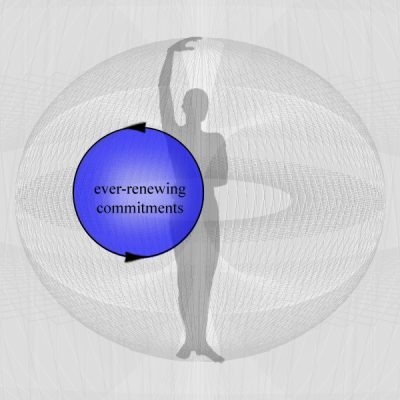 The Q, U, and Z-nodes represent modes of experiencing in the I-phase, modes of attending in the O-phase, and modes of valuing/evaluating in the A-phase.
Q of W (in I) = experiencing as self; Q of P (in O) = focused attending; while Q-proper (in A) = willing/committing to valuing.
The spheres represent the ultimate cyclic/recursive character of any activity (experiencing, attending, or valuing).
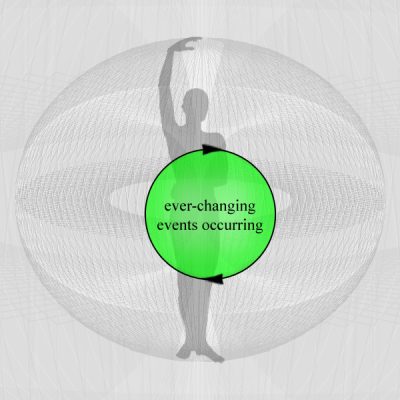 The Q, U, and Z-nodes represent modes of experiencing in the I-phase, modes of attending in the O-phase, and modes of valuing/evaluating in the A-phase.
U of W (in I) = experiencing as dynamic; U of N (in O) = rhythmic attending; while U-proper (in A) = currently valuing.
The spheres represent the ultimate cyclic/recursive character of any activity (experiencing, attending, or valuing).
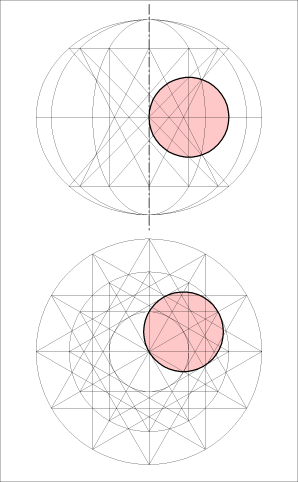
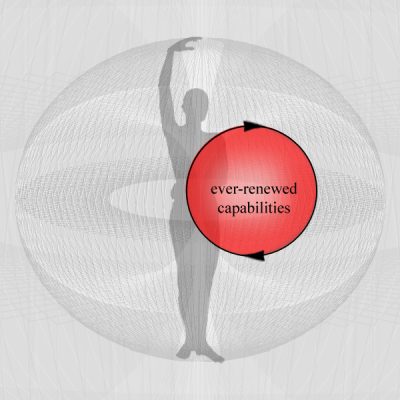 The Q, U, and Z-nodes represent modes of experiencing in the I-phase, modes of attending in the O-phase, and modes of valuing/evaluating in the A-phase.
Z of W (in I) = experiencing as world; Z of M (in O) = holistic attending; while Z-proper (in A) = capacity for valuing.
The spheres represent the ultimate cyclic/recursive character of any activity (experiencing, attending, or valuing).
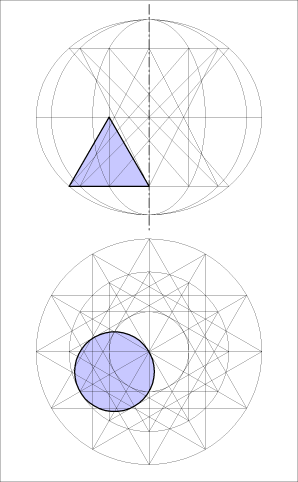
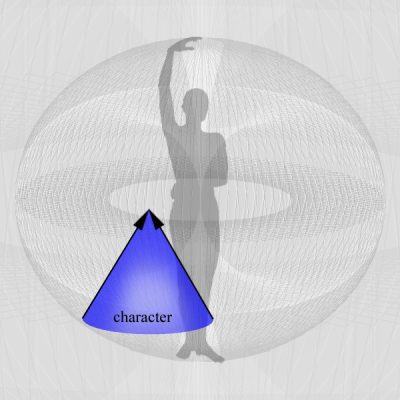 The R-node symbol combines a cone pointing up with the color blue. With reference to the I-phase, this means experienced as self—that which is thrown before oneself uniquely. With reference to the O-phase, it refers to qualia as objects of attention. When applied to the A-phase dealing with value, the logic of this term gets interpreted according to actual, practical (self/world) engagement over time, with the past below, the future above, and the present stretched out before us. In this case, the cone pointing up is convergently bringing our past to bear on our present circumstances. Its apex is in the present, and it's gathering together various influences from our past. It identifies our current state given our history: our is (as in the is/ought distinction), representing what we currently value, given our background. In this case, the cone is not so much a being-thrown-before as it is in the K-node of the I-phase, or an object of attention as it is in the O-phase; here it is being-thrown-together, con-jecturing with respect to the feeling of that which is currently presentated before us. The cone pointing up thus means valued, and together with the color blue, the R-node symbol means valued by me, representing the quality of one's character.
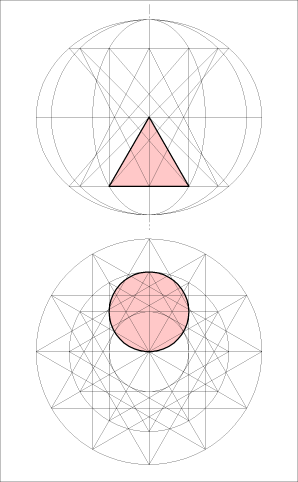
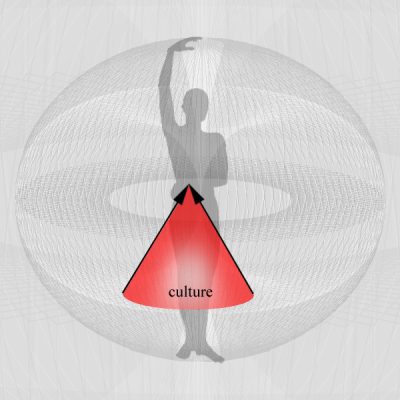 The X-node symbol combines a cone pointing up with the color red. With reference to the I-phase, this means experienced as world—what is commonly thrown before those of a given ordered system. With reference to the O-phase, it refers to the significance of worlds as objects of attention. When applied to the A-phase dealing with value, the logic of this term gets interpreted according to actual, practical (self/world) engagement over time, with the past below, the future above, and the present stretched out before us. In this case, the cone pointing up is convergently bringing our past to bear on our present circumstances. Its apex is in the present, and it's gathering together various influences from our past. It identifies our current state given our history: our is (as in the is/ought distinction), representing what we currently value, given our background. In this case, the cone is not so much a being-thrown-before as it is in the K-node of the I-phase, or an object of attention as it is in the O-phase; here it is being-thrown-together, con-jecturing with respect to the significance of that which is currently presentated before us. The cone pointing up thus means valued, and together with the color red, the X-node symbol means valued by us, representing the character of our culture.
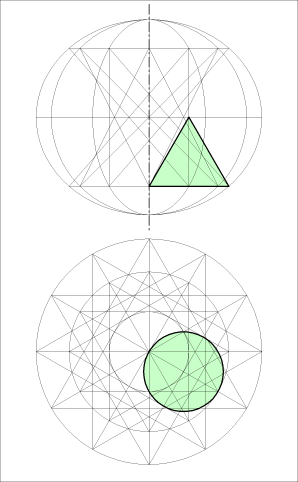
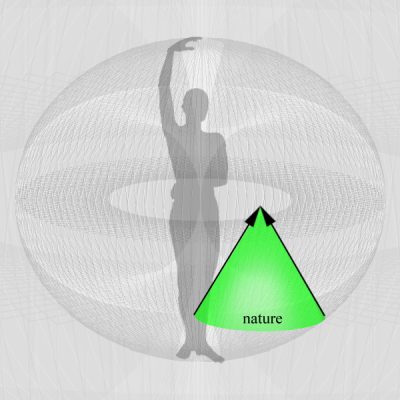 The V-node symbol combines a cone pointing up with the color green. With reference to the I-phase, this means experienced as dynamic; an ever-changing world is thrown before us. With reference to the O-phase, it refers to facts/events/states of affairs as objects of attention. When applied to the A-phase dealing with value, the logic of this term gets interpreted according to actual, practical (self/world) engagement over time, with the past below, the future above, and the present stretched out before us. In this case, the cone pointing up is convergently bringing our past to bear on our present circumstances. Its apex is in the present, and it's gathering together various influences from our past. It identifies our current state given our history: our is (as in the is/ought distinction), representing what we currently value, given our background. In this case, the cone is not so much a being-thrown-before as it is in the K-node of the I-phase, or an object of attention as it is in the O-phase; here it is being-thrown-together, con-jecturing with respect to the interpretation of that which is currently presentated before us. The cone pointing up thus means valued, and together with the color green, the V-node symbol means valued in itself, representing that which is valued by nature.
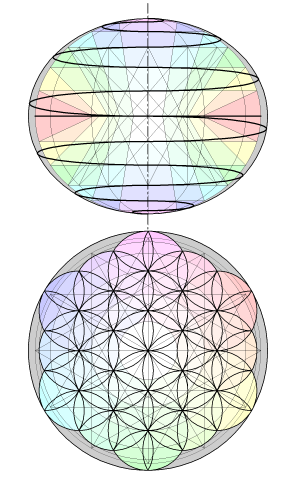
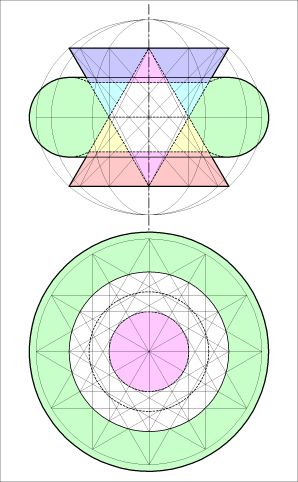
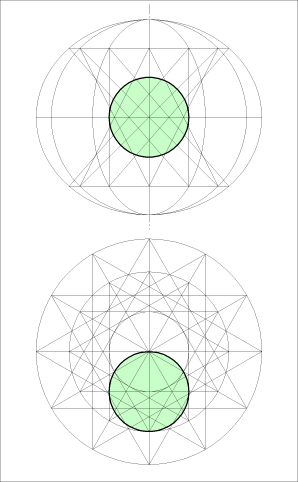
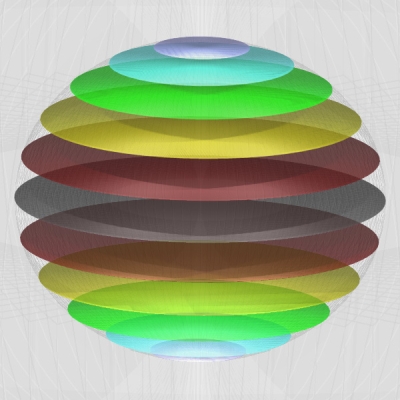 This is the bottom line—the plane of presence constituting a mixture of I, O, and A—the concrete particular experiences that lend existence its meaningfulness. L-nodes can be conceived of and represented in a couple of different ways: 1) as six horizontally oriented disks, related to each other as if six pieces in one pie; and 2) as a spiral marking out six stages in a developmental progression. These in turn get interpreted according to different terms, including as concentric circles of concern (each wider in scope), as different levels in a growth (not dominance) hierarchy, as timespans of different durations, as degrees of the tree's unfolding/folding up, and possibly others; where the inner circle = simplest/basic level = shortest timespan = flattest tree; and the outer circle = integration of complexities = long-term timespan = most-opened tree.
The images to the left attempt to symbolically capture the various ways the L-phase can be conceived. First, recall that the images represent two views of the same 3D figure. The top image is the figure as viewed from one side, while the bottom image is the same figure as viewed from above. In the top image, the interpretation of L-nodes as different levels in a developmental progression is depicted as the tree is shown in various stages of its unfolding/folding up. Levels toward the axis are simpler but more abstract, while levels toward the horizon are more complex but more concrete. Connecting the levels with color, the more abstract levels tend toward magenta and white, while the concrete levels tend toward red and black. Looking now at the bottom image to the left, the overlapping circles are meant to occur as the flattened horizon, appearing as an horizontal line along the middle of the top image. Some creative license has been taken in depicting the horizon in this way. The overlapping circles do not result from the tree flattening at the horizon; rather, they are together a symbolic extension of the pattern seen in the corresponding view of the A-phase symbol. The colors in the bottom image depict the six nodes of the L-phase as six pieces in one pie. Finally, the spiral in the top image is meant to indicate the horizonal disk as wobbling, where the wobbling corresponds to degrees of the tree's unfolding along a developmental progression.
The correspondence between the colors and the degrees of the tree's unfolding can be seen in this simplified progression (left to right: L, D, G, C, E, B, F):
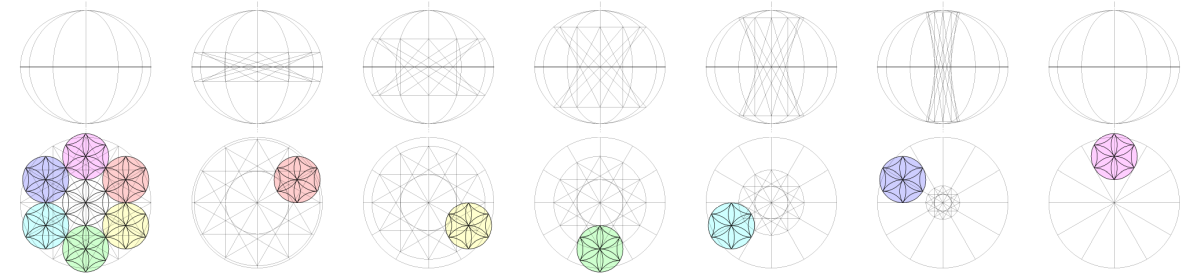
The L-nodes together form an interconnected network—a single disk that wobbles as it travels along the system's axis, tracing out a spiral of progression.
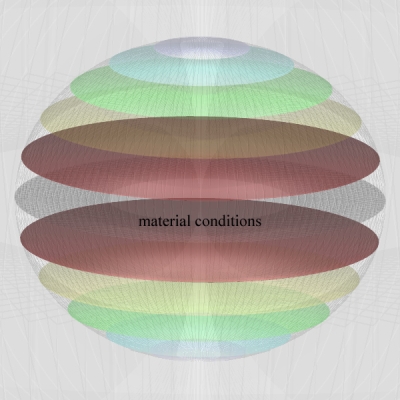
The symbols for L-phase nodes are horizontally oriented disks, but they're wobbling disks, and so they extend more or less into the vertical dimension, marking out levels in a developmental progression. The D-node is closest to the flattened black disk representing ideally-opaque materiality; its wobble doesn't extend far into verticality. It thereby also represents the first of six stages in a developmental progression.
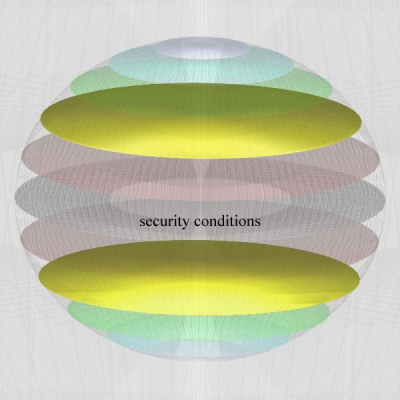
The symbols for L-phase nodes are horizontally oriented disks, but they're wobbling disks, and so they extend more or less into the vertical dimension, marking out levels in a developmental progression. The G-node is second closest (after D) to the flattened black disk representing ideally-opaque materiality; its wobble moderately extends into verticality. It thereby also represents the second of six stages in a developmental progression.
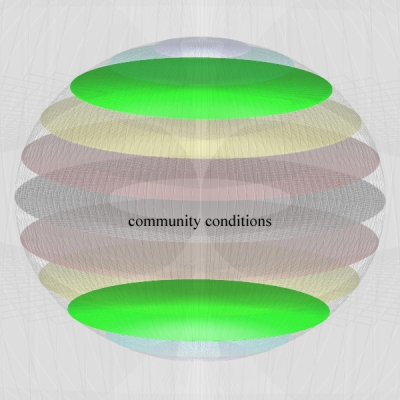
The symbols for L-phase nodes are horizontally oriented disks, but they're wobbling disks, and so they extend more or less into the vertical dimension, marking out levels in a developmental progression. The C-node occurs mid-way between the horizontally flattened black disk representing ideally-opaque materiality and the vertical axis representing ideality; it thereby represents a middle stage—the third of six—in a developmental progression.
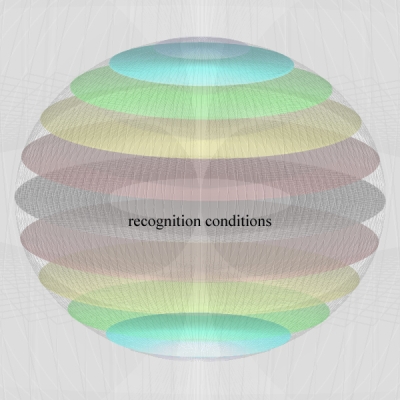
The symbols for L-phase nodes are horizontally oriented disks, but they're wobbling disks, and so they extend more or less into the vertical dimension, marking out levels in a developmental progression. The E-node occurs just past mid-way between the horizontally flattened black disk representing ideally-opaque materiality and the vertical axis representing ideality; it thereby represents the fourth of six stages in a developmental progression.
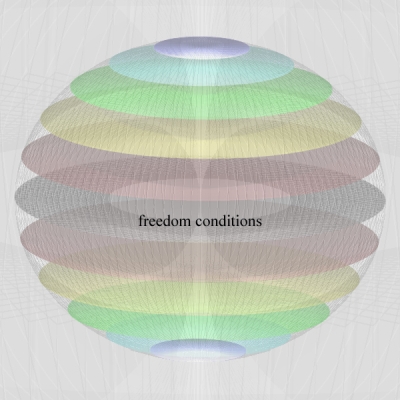
The symbols for L-phase nodes are horizontally oriented disks, but they're wobbling disks, and so they extend more or less into the vertical dimension, marking out levels in a developmental progression. The B-node occurs near the vertical axis representing ideality; it thereby represents an advanced stage in a developmental progression—the fifth of six.
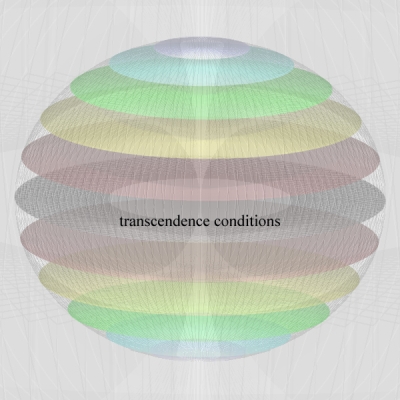
The symbols for L-phase nodes are horizontally oriented disks, but they're wobbling disks, and so they extend more or less into the vertical dimension, marking out levels in a developmental progression. The F-node resolves into the vertical axis representing ideality; it thereby represents the final stage in a developmental progression, just before another developmental progression of higher order begins. At the completion of each developmental progression, greater orders of complexity are integrated into a more richly complex whole.


