







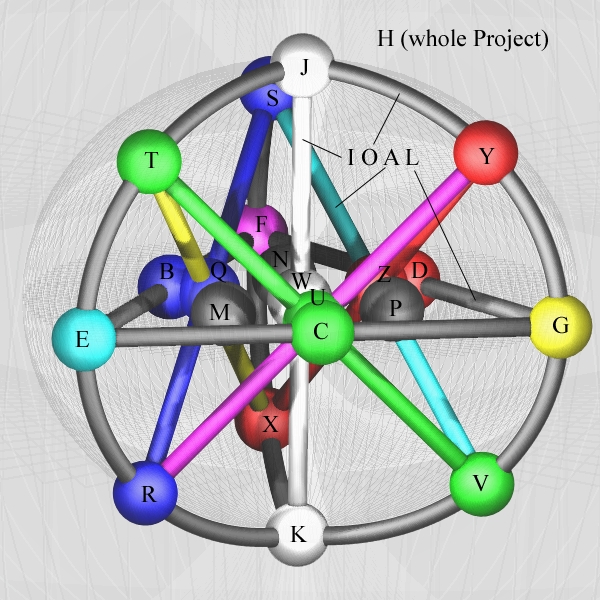
The Project's core structure involves 26 questions. These questions are informed by the underlying logic from which they emerged. Since the questions may be restated—i.e., since the terms in which the Project's main divisions/questions are understood might be reconceived depending on the context—it is desirable to identify some abstract way to refer to these 26 constitutive elements separate from any specific content they express. To this end, each of the 26 is assigned one letter of the Latin alphabet.
Yet letters themselves are not purely abstract; they already bear some meaning given their histories, their shapes, the words in which they commonly appear, and so on. So, the assignment of letters in this Project is not purely arbitrary. Moreover, the tenuous meanings each letter individually bears can't be forcibly wiped clean by their linear assignation to the Project since the Project itself is not linear in nature; any linear assignation of letters to a non-linear system would create the false illusion of linearity. The assignment of letters to this Project's questions must therefore be an act of creative appropriation given a mixture of the following considerations:
Here's a chart showing the approximate origins of the current Latin alphabet with suggested numerical values (and subsequent order changes) for Latin letters given the alphabet's history:

The changes to the current sequence that need to be justified are: 1) the order reversal of I and J, 2) the insertion of W between N and O, and 3) the alignment of proposed numerical values with modern Hebrew rather than the more closely related (evolutionarily speaking) modern Greek—hence the gap between P and Q. I'll take them each in turn.
1) The order reversal of I and J. First, J is a newcomer to the alphabet; it emerged from I. The deep history of J just is the history of I. Therefore, the order they appear with respect to each other is of secondary importance to I's original placement in the alphabet order with respect to the other letters. In the first abjads/alphabets, the letter teth (Hebrew tet and Greek theta) appeared between the H- and I-equivalents in those systems. Since this letter teth/tet/theta has no Latin equivalent, there's a gap in the order there. So, it makes sense to fill that gap with the Latin J to preserve the original order.
2) The insertion of W between N and O. Once again, in the original abjad/alphabet sequence, there was a letter samekh that appeared between the N-equivalent (nun) and the O-equivalent (ayin). Since there is no Latin equivalent of samekh, a gap is opened between N and O. Moreover, our letters after the letter T didn't appear in the first alphabets, so we have surplus letters, one of which can be used to fill this gap. And why is it desirable to fill the gap and not simply shift the letters down, closing it? It's because of the numerical associations with the letters—just like J and I: I is the original letter from which J recently emerged. I's numercial value has always been 10. In the current order of the Latin alphabet, since I comes before J in order, I would be 9 while J would be 10. But, again, since J emerged from I, it seems more fitting that it shouldn't bump I from its traditional position in the sequence. And so there's a similar case with the gap between N and O. The numerical value of N has traditionally been 50, while the numberical value of O has been 70. Samekh was 60, and since there's no Latin equivalent to 60, it's good to find one. W is a good candidate, given its affinity with vav/F/6 (see more at W.)
3) The alignment of proposed numercial values with Hebrew rather than the more closely related Greek. Beginning at Q, the modern Hebrew and Greek numerical equivalents differ. In Hebrew the Q-equivalent (kuf) is 100, while in Greek the Q-equivalent (koppa) is 90. (See Greek isopsephy vs. Hebrew gematria.) Again, in the original alphabets, there was an additional letter between P and Q. That letter is retained in the Hebrew as tsade, having the numerical value of 90, but there is no modern Greek equivalent. Rather than leave a gap in their numbering, the Greeks shifted their letter values at Q. So, I align the numeric values with the Hebrew over the Greek for two reasons: a) it more closely maps onto the order of the original abjads/alphabets, and b) the numerical values of letters is more important in the Hebraic tradition (with Kabbalah's gematria) than the Greek one.
Given these considerations, the following proposed letter associations are advanced. Justifications for these particular assignments can be found below.
_selected resources
• History of the alphabet (Wikipedia)
• Albright, W. F. (1969) The Proto-Sinaitic inscriptions and their decipherment [Harvard UP]
• Goldwasser, O. (2006) Canaanites reading hieroglyphs [Ägypten und Levante 16, 121-160]
• Hamilton, G. J. (2006) The origins of the Western Semitic alphabet in Egyptian scripts [Catholic Biblical Association]
The main reasons the letter H is used to indicate existence (or designate the Project as a whole) are the sound the letter makes and its original meaning.
For English speakers, the letter H makes the subtlest of sounds—merely the passage of breath through the mouth—and so it seems appropriate to use it to indicate the subtlest of questions.
Also, it is thought that the letter originally meant fence or boundary. In this sense, the letter might be thought to indicate an horizon—even the broadest most horizon in which all that is can be meaningfully said to be—namely, the horizon of being itself.
Beyond the primary reasons for assigning the letter H to indicate the Project as a whole are a couple of creative coincidentals of note. H is the first letter of the English word horizon, but also home. Also, the numerical value of the letter H from history is 8, and the Arabic numeral 8 resembles the infinity sign. The Project's horizon demarks the Project's limits, yet this horizon is paradoxically both finite and infinite. The "bounded infinity" can be seen in the image of the Project's tree structure as shown on the Welcome page.
The letter I resembles the vertical axis about which this Project turns, and so it's used to represent the phase of the Project's tree when folded up as an axis.
Originally, the letter I (yod) depicted a hand, or arm with hand. Hands have been connected with rationality (see Aristotle, Parts of animals [687a2-687a23] and Gallagher, S. (2018) Embodied rationality. In G. Bronner & F. Di Iorio, eds. The mystery of rationality, pp. 83-94 [Springer]). This connection is appropriate since this Project's I-phase concerns the ideal (ideational), thus rational, dimension of experience. We speak of grasping ideas as well as grasping objects with our hands. "If we wish to convey that we have acquired something mental, we say that we have grasped it" —Révész, G. (1943) The human hand: A psychological study [J. Cohen, trans. Routledge & Kegan Paul 1958]. (See also—apprehend.) Moreover, I as hand is intimately related to O as eye in the hand-eye coordination critical for sense-making/embodied cognition.
Symbolically, I (yod/iota) is a seed of potential. It's pure, unactualized, unmanifest potential. An abstract/virtual axis locates this potential relative to manifest reality. I's potential actualizes in O (symbolically the ovum/soil).
J is a modification of I. According to Wikipedia, "Gian Giorgio Trissino (1478-1550) was the first to explicitly distinguish I and J as representing separate sounds." If I symbolically represents pure potential, J may be thought of as potential for subjective individuation. It splits reality into realities.
In terms of Jungian psychology, J is (perhaps) as the ego-aspect of the complete psyche/Self (I). J is the individuated subject, freed from the collective unconscious; it's an unique point-of-view unshared with others. The psyche's real power (potency) is contained within the unconscious, yet this can be harnessed by the ego.
In terms of Plato's tripartite conception of the human soul, J would perhaps be the rational part. In his simile comparing the human soul to a charioteer together with a team of horses, J is the charioteer which is capable of harnessing/steering the horses representing the non-rational appetitive and spirited forces at work in one's psyche. Power resides with the horses. J is therefore an im-potent version of the potent I.
In terms of non-dual South Asian philosophy, J is as the ego's wave-crest on the ocean of true Self (Atman/I). Once again, power resides with the ocean. Or, J is the eddy in I's river—an eddy with a localized and temporary axis of its own.
Power resides in I's potency, but I's power is limitless and undirected. J, while relatively impotent itself, taps into the power of I, giving it direction around which order accrues.
I've gone quite far afield with this analysis. You might be rightly asking yourself, what's this got to do with letters? The answer is: not much. I'm just riffing off the I/J association in the context of the types of questions that might be taken up as I- and J-type questions.
W is an odd letter insofar as it was added to the alphabet relatively recently. It can't be unambiguously traced back to any letter of the original alphabet. But it does have some affinities with a few of those original letters. First, graphically, the Phoenician letter shin resembles a modern W. The letter shin likely originally represented either a bow (the hunting tool) or a tooth. But the letter shin, since it appears between resh/R and tav/T in the early alphabets, is more naturally associated with the letter S. Yet the original alphabets contained three letters that might be associated with S: shin, samekh, and tzadi, and samekh and tzadi each have no obvious Latin alphabet decendent.
While the letter shin bears a graphic resemblance to our W, the closest affinity with W in the early alphabets/abjads is the letter vav which occupies the position in the original abjad that our the letter F now occupies. It is thought that vav originally meant mace or hook. And the letter vav commonly gets transliterated as V or W, as the pronunciation of vav was likely close to a W sound. Additionally, V and W have natural affinities with our letter U, all of which emerged from the Greek upsilon—and none appeared in the original Semitic abjads, except insofar as they stood in place of vav, today's F.
So, W has affinities with S—directly with shin (according to shape), and indirectly (through shin) with samekh and tzadi (as variants of S), and it has affinities with F along with U and V.
Samekh and vav have an affinity between them. Vav's numerical equivalent is 6 while samekh's is 60. And since there is no modern letter in the place of samekh/60, and because of the numerical connection with vav, a good place for W is between N (50) and O (70), taking for itself the numberic value of 60, while V takes 600, leaving U in line with the Archaic Greek's placement of Upsilon. The alternative would be to place W in place of tzadi/90. Again, because of it's association with F/6 and V/600, W is more akin to 60 than 90.
The original image used for samekh was that of an Egyptian djed, or pillar, and the original image used for tzadi was that of a reed, likely of papyrus. Moreover, it is possible that a djed was originally a pillar made of bunched reeds (Pinch, G. [2002] Handbook of Egyptian Mythology, pg. 127), connecting the two symbols. Also, "some early uses of the djed symbol imply that it could be thought of as a pillar holding the sky above the earth" (ibid., 128). It is between the earth and sky that intelligibility occurs by rhythmic measure. W is thus best suited to take the place of a bound bunch of reeds (the graduated djed symbol) rather than a single clump of reeds, as it represents the dynamic relationship between self and world that holds open (supports) a "space" for meaning's occurrence. So, again, W takes the place of samekh/60/djed/pillar of support.
Aside from the position W holds in the alphabet, here are a couple ways we might creatively conceive of W's meaning. W can be thought of as a bow (the original pictogram for the letter shin which resembles a W in shape). A bow holds tension—in this case the tension between self and world. This tension is that which allows the system to maintain its integrity as an interconnected system. So, if self and world are thought of as two sides of the same coin, let's say, the tension of W is what allows these two sides to be pulled apart from one another while remaining connected. (Heraclitus [DK 51]: "They do not understand how that which differs with itself is in agreement: harmony consists of opposing tension, like that of the bow and the lyre.") Also, W's connection with the mace or hook of vav/F might be thought of in terms of the ego-Self axis—the tether tying together the conscious and predominantly unconcious aspects of the psyche—or the golden thread maintaining the connection between self and world. Finally, and this one's even more of a stretch (no pun intended), we might think of this link that W makes—either as bow or mace/hook—in terms of reciprocity. There's a reciprocal movement between self and world, or ego and Self. This movement is dialogical, going back-and-forth. So, graphically, a W is like this dialogical movement as re-ci-pro-ci-tas (back-and-forth-ness).
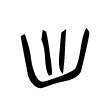
Just as the letter I originally meant hand, the letter K originally meant palm (of the hand). It's an open palm ready to take hold and grasp. It's the potential for grasping. What makes grasping possible is in part that there is something capable of being grasped. And so K may represent that which is capable of being taken hold of, or grasped—viz., some aspect of the world, where world means domain of intelligibility. A world is a region of reality capable of being grasped—an order or orderly arrangement (kosmos). So, just as J represents the potential for selfhood, K represents the potential for worldhood—i.e., that it's possible for reality to present itself as intelligible.
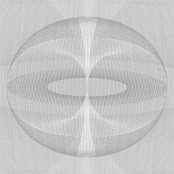
As the Project's tree-structure (diagramming its logic) folds and unfolds, it scribes arcs which, when looked at from the side, resemble a circle; that's one reason the letter O is used to represent this phase of the Project.
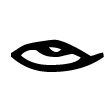 The original meaning of the letter O is eye (as in oculus [L] or ops/optikos [G]). This suggests a point-of-view which is limited by a field of view. The letter O is thus applied to the questions concerning intelligibility, as any particular experience occurs from a point-of-view within a domain of intelligibility. Going along with this, the graphic representation of the letter O at once suggests the shape of an eye and a bounded world (domain of intelligibility).
Relatedly, O's shape may signify ovum (egg). It is within this egg that the seed of potential (I) may germinate and grow, becoming actual (A), to ultimately bear fruit (L).
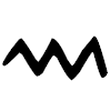
Our letter M descends from the Proto-Sinaitic letter mem which depicted water. This original meaning works well to signify subjectivity. Subjectivity involves how one feels given one's position in the world, and feelings run deeper than thoughts. While feelings often (if not always) involve judgments, the judgments made are typically pre-consicous and closer to the psyche's unconsicous, and the unconscious might be thought of as a sea of meanings all mixed together. Think of the way the contents of dreams change radically without seeming out of the ordinary. In a dream, for instance, one moment you're playing tennis with your dentist and the next your dentist becomes your ex-wife and the tennis court is no longer in the park but on the roof of your old house. The meanings are all mixed up, because what's important is not the semantic content of the dream but the symbolic content. And symbolism is important for holistically attending to truth subjectively.
Words for mother in languages derived from Indo-European roots typically begin with the letter M, since the Indo-European root mater means mother. Related words include maternal, matrix, metro-, material, matter, and so on. One might object that associating motherhood with material, matter, subjectivity, and the unconscious mistakenly associates femininity and thereby womanhood with those features of our experience that traditionally we've been taught to overcome or otherwise dominate—by way of ideals, ideas, objectivity, and conscious reflection. One might object that to continue to identify feelings with femininity and thoughts with masculinity is to perpetuate patriarchy—that to continue to relate womanhood with the deeper, more primal reality of the unconscious is to continue to associate womanhood with animality, the animality to be transcended by reasoned conscious reflection—what is properly human—what is male. To connect M as in mother with subjectivity and P as in pater/father with objectivity is to run the risk of falling into the old patterns of encouraging patriarchal domination. But we can avoid this error by considering subjectivity in its own right rather than as a deficient mode of objectivity. Derivative of objectivity, subjectivity typically involves biases or concerns peculiar to an individual. But subjectivity in itself mainly invovles the holistic what-it's-like-ness of an experience. For example, there's a what-it's-like to be a dog, or a human, or a human of a given race within a given culture. Now, of course there will be a what-it's-like to be me given my peculiar history, but mostly what-it's-like to be me is just like what-it's-like to be anyone like me and who shares my world. So subjectivity is mostly—by far—shared. Subjectivity mostly means empathy.
But again, unfortunately, subjectivity has heretofore been patriarchally defined. Subjectivity has been defined as a diminshed mode of objectivity, where it is the point of view of an narrow observer that is adopted in both. But this Project aims to redefine subjectivity in a way that reclaims it from patriarchy. Subjectivity does not involve knowing as an isolated/autonomous/Cartesian-styled/egoic subject or observer. It involves expanding one's attention to encompass the context (world) by becoming immersed in it. When subjectivity is a mode of a subject/narrowly-focused observer, it merely becomes trapped in its isolated sphere. But when subjectivity properly involves a mode of open/receptive attending (experiencing as world), to adopt this point of view means to exapand one's sense of self far beyond that of the automomous ego. The self becomes a durational process connecting a web of relations. The self becomes, not that which narrowly observes, but that which undergoes. And what is known (immediately, as if feeling the known) is the complex web of dynamics connecting one's peculiar self to the larger context through which it is moving as an embedded part thereof.
In this light, patriarchy clearly hasn't just been a problem for women; it's been a problem for all of us. To marginalize the importance of a full, deep, immersed experience of the world in favor of merely capturing propositional snapshots of the world does everyone a disservice. It constitutes an impoverishment of experience—a tendency toward groundlessness. To identify femininity as representative of deep, holistic, flexible connectivity is to celebrate femininity.
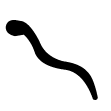
The first letter N (nun) was taken from an Egyptian hieroglyph that depicted a viper or cobra, and it is thought that the letter may have come to mean sea snake—perhaps symbolically a generative "moving over the surface of the waters" (Genesis 1:2).
Moreover, as activity (active intelligibility) can either be thought of as skillful knowledge within a domain or the activity of opening the domain in the first place, N is simultaneously the child and parent of M and P—the original birth (as in nature/natura, from natus, past participle of nasci "to be born"). This active/generative association makes N a fitting letter to indicate the active intelligibility that rhythmically clears space for meaning to occur—the rhythm that discloses worlds. See also—nexus.
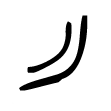
P as in pater (father), representing the masculine. In this Project, P represents a mode of attending that narrows its focus. This could relate to masculinity insofar as predator/hunters focus on their prey, and as our species evolved, men were typically the hunters (right?).
The letter P may have originally meant mouth. This can be connected with speech and articulating propositional claims about the world, the truth of which must be determined objectively.
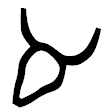
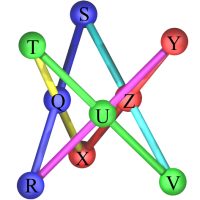
Orthogonally represented, this phase of the tree's unfolding resembles the combination of an A, V, and X ( ), and A is the best sign to represent this phase for reasons including the following.
The letter A began as a pictogram of an ox. As ox is what we call any bovine that has been trained to do work, an ox may be thought to represent the harnessing of primal energy. This connection with work-energy makes it an apt letter to associate with the phase of our Project dealing most directly with practical activity.
Moreover, if Heidegger's right and we first understand our world in terms of know-how—i.e., through our pre-cognitive engagement therewith—this is where meaning originates, and so it's appropriate to assign this phase the first letter of the alphabet. ...At any rate, it's where this Project originated. The other phases emerged out of the logic of the A-phase.
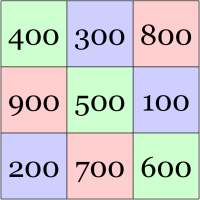
A-phase nodes are assigned the letters Q through Z (except W) because of their numerical values, as arranged in a magic square, in keeping with the spirit of the Project's balanced, self-cancelling terms. All columns and rows sum to 1500 and, given color, cancel to white (blue + green + red light = white light):
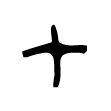
The letter T is used to represent this node primarily given the relation of its traditional numerical value (400) to the other A-phase nodes as arranged in a magic square. See A for an explanation.
The letter T originally meant mark. Perhaps this meant owner's mark, but we could also think of this mark as a point toward which we take aim, like a bullseye. This is a T as in telos—or end—toward which a movement is occurring. A movement is aimed at its completion, and this completion may not be a cessasion but a perfection of the movement—perfection in harmony, consistency, rhythm, and so on.
The letter S is used to represent this node primarily given the relation of its traditional numerical value (300) to the other A-phase nodes as arranged in a magic square. See A for an explanation.
The letter Y is used to represent this node primarily given the relation of its proposed numerical value (800) to the other A-phase nodes as arranged in a magic square. See A for an explanation.
The letter Q is used to represent this node primarily given the relation of its traditional numerical value (100) to the other A-phase nodes as arranged in a magic square. See A for an explanation.
What the original letter qoph depicted isn't unambiguous. Some say it shows a needle with its eye. Some say it shows a monkey with its tail. Yet others say it shows the nape of a neck with the back of a human head. In any case, rather than our Q's shape involving a circle with a diagonal mark in the corner, the Phoenician qoph, archaic Greek koppa, and archaic Latin ku all involved a vertical segment with a small loop at the top. Will/agency is typically thought of in terms of verticality. Things take a stand by force of will, and a commitment is an ongoing willing—an ongoing choice to take a stand—the ancient Q-signs work nicely to represent this node addressing the agency to will and make commitments. Furthermore, if we interpret the ancient sign as depicting a nape and head, that once again works well as a sign for choice, will, and commitment, as choices are deliberate, and deliberation is associated with the head (perhaps as erect and looking straight away).
The letter U is used to represent this node primarily given the relation of its proposed numerical value (500) to the other A-phase nodes as arranged in a magic square. See A for an explanation.
The letters U and W were derived relatively recently from the classical Latin V, which ultimately has its root in the ancient letter vav. This Project's U and W nodes are key nodes, each involving the doubly-dynamic discursive, reciprocal, part-to-whole hermeneutic activity that thematically permeates this entire Project (as captured by the torus symbol).
The letter Z is used to represent this node primarily given the relation of its proposed numerical value (900) to the other A-phase nodes as arranged in a magic square. See A for an explanation.
With a healthy dose of creative license, we might think of the letter Z—the last letter in the alphabet—in association with ultimate limiting conditions. Then we might consider the limiting conditions of experience—one's own ultimate limiting conditions—and those would be that which we're capable of experiencing. The Z-node refers to abilities. Naturally, everything we do must be considered something we're able do, and so this will include basic things like perceiving, willing, imagining, acting/behaving, and so on. Even attending to the world in an holistic mode will necessarily be limited. It will be limited by one's capacity to attend. These limitations make it possible to attend in the first place, or to act, imagine, will, perceive, and so on.
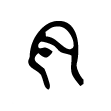
The letter R is used to represent this node primarily given the relation of its traditional numerical value (200) to the other A-phase nodes as arranged in a magic square. See A for an explanation.
One secondary reason might be: R was originally a pictogram of a human head in profile. Now, it's possible that we'd be more likely to assign the quality of someone's character to their hearts, but inasmuch as the quality of one's character will allow them to exercise judgment for good or ill, and insofar as judgment is a function of (usually practical) reason, and insofar as reason is associated with the head (or brain), we might make the connection between character and R. At any rate, it's a picture of an individual head—not a group—and so this is a good sign to indicate personal character.
The letter X is used to represent this node primarily given the relation of its proposed numerical value (700) to the other A-phase nodes as arranged in a magic square. See A for an explanation.
Additionally, with a little imagination, we might think of X as signifying a crossroads. People of different cultures meet at crossroads, and the X-node addresses cultural values. Thinking of X in this way might help us remember that we live in a world with people of many cultures, and it can be enriching to meet them at the crossroads. Presenting to us new possibilities, encounters with alternate modes of being can help us critically assess our own otherwise taken-for-granted cultural values, and the dialogue can broaden the horizons of both parties. Yet we must first make the choice to engage.
The letter V is used to represent this node primarily given the relation of its proposed numerical value (600) to the other A-phase nodes as arranged in a magic square. See A for an explanation.
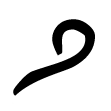
The letter L is used to represent this phase primarily for two reasons: 1) the letter's shape, combining the horizontal element at its base (representing the ideally opaque materio-causal continuum of what we call the physical universe) with the vertical element (representing time and so development); and 2) the letter's original meaning as goad (or, more generally, training instrument). Ox (letter A) and goad (letter L) go together insofar as it's the goad that transforms a mere bovine into an ox capable of doing work. The ox has been trained; it has learned how to work. It is by the goad that the bovine's primal energy has been harnessed. There's a dual connection here between goad and the Project's L-phase. a) The conditions of one's life goad one to pursue certain possibilites and not others. A synonym for goad is constrain. The L-phase investigates the concrete conditions which constrain experience—limiting it concretely and thereby making it possible. b) As goad, the L-phase has a pedagogical connotation. It's the education of the ox. It conditions development and the stages in that development. This Project's L-phase addresses not only the concrete conditions for experience, but also levels of conditions as stages of development—levels arranged in a growth (not dominance) hierarchy.
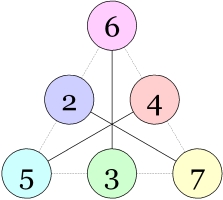
Like the A-phase nodes, L-phase nodes are assigned the letters they are—in this case B through G—primarily because of their numerical values, again in the spirit of this Project's balanced, self-cancelling terms. Opposites sum to 9 and, given color, cancel to white:
The letter F is used to represent this node primarily given the relation of its traditional numerical value (6) to the other L-phase nodes as arranged in a triangle. See L for an explanation.
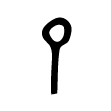 Our letter F is derived from a sign (the letter vav) probably depicting a mace with handle and head such that the sign is a vertical segment with a small circle at the top. Graphically, and with a healthy helping of creative appropriation, the vertical segment could represent a resonant connection between self and world—or psychological and physiological—as in the alchemical "as above, so below" (often symbolized by an hexagram) or the Biblical "on earth as it is in heaven" (Matthew 6:10). In each case, the connection expresses an ultimate non-duality. This non-duality doesn't mean that two elements cancel to 0, and it doesn't mean that two elements become 1; it's both of these yet neither. It's indeterminate, transcending our ability to conceptualize.
It's also worth noting that vav was very prolific, giving us not only our F, but also our U, V, W, and Y. All of the nodes associated with these additional letters (except Y) express activity in some way—as experiencing as such in the case of W, as a particular mode of experiencing/attending/valuing in the case of U, and as the dynamic presentation of that which is experienced in the case of V. This reinforces the interpretation of F as involving a resonant connection and not a static connection. Moreover, while U and W occupy central positions in the A- and I-phases, respectively, it's fitting that F occupies a central position (together with C) in the L-phase.
The letter B is used to represent this node primarily given the relation of its traditional numerical value (2) to the other L-phase nodes as arranged in a triangle. See L for an explanation.
 Originally depicting a house, the letter beth (B) suggests the basic duality of inner and outer, where inner and outer are analogous to psychological and physiological (conditions) respectively, and where B is associated with inner/psychological. For instance, the Hebrew letter bet (ב) can be used as a prefix meaning within. This simplest of divisions can be thought to mirror, for example, the distinction important in Stoicism recognizing the difference between what's in our control and what's not. We can't always control the external circumstances of our lives, but, with discipline, we can at least control how we respond to those circumstances, both in attitude and in action. In other words, we can to a great extent control the quality of our character—an important part of our psyche. So, with self-discipline, by taking full responsibility for those things in our control, we can free ourselves from unnecessary worry and more easily find our proper place in the world. These ideas work well with this Project's B-node addressing conditions pertaining to liberty and the freedom that comes with self-actualization.
The letter E is used to represent this node primarily given the relation of its traditional numerical value (5) to the other L-phase nodes as arranged in a triangle. See L for an explanation.
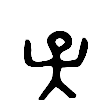 The original letter for E (he) depicted a human with raised arms—praising, shouting in surprise "Ha!" or calling "Hey!" The E-node pertains to recognition. Admitedly this is a stretch, but as praising or shouting "Ha!" the human figure letter E is recognizing. As shouting "Hey!" the figure is catching our attention and so being recognized. A moment of recognition in either direction is cause for celebration/jubiliation (another attribute ascribed to the letter he).
Hamilton on he (from [2006] The Origins of the Western Semitic Alphabet in Egyptian Scripts): "As the only letter depicting a full human being in the early alphabet, it was the one to which particles of direct speech, an [onomatopoeic] interjection of lament or joy, *oy, 'ah!' or 'ha!' and one of immediacy, *hi, 'here!' were attached" (85-86). A demonstrative "particle of direct speech," for example, functions to direct attention. Combining sociological and psychological conditions, the E-node could represent directing attention, where the directing occurs in a social context and the attention is directed toward someone's psychological condition. Recognizing specifically involves directing attention.
The letter C is used to represent this node primarily given the relation of its traditional numerical value (3) to the other L-phase nodes as arranged in a triangle. See L for an explanation.
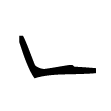 The letter C was derived from the Semitic letter gimel which may have originally meant throw-stick. A throw-stick in use makes an active connection between thrower and that toward which the stick is thrown—an active connection between self and other. This fits nicely with the Project's C-node, which involves sociological conditions, and especially the activities of sharing and exchanging. Moreover, a throw-stick is often a boomerang. This fits even more nicely with the Project's C-node, indicating a reciprocal (back-and-forth) action of exchange, communication, sharing between individuals in a society, and love as an activity.
The letter G is used to represent this node primarily given the relation of its proposed numerical value (7) to the other L-phase nodes as arranged in a triangle. See L for an explanation.
 The Latin letter G was derived from the letter C to distinguish between the /k/ and /g/ sounds. Our letter C takes the place of the original gimel, while our letter G takes the place of the original zayin, which became our Z. If we were to associate zayin with G rather than Z, G would mean ax. Axes chop, just like the objective observation of facts chops the world into manageable chunks, and, in the field of objectivity (P), the G-node combines experiencer with that which is experienced—that is, it combines an universal point of view (Y) with the instrinsically valued facts of nature (V); from out of this relation we reap the assertions of propositional knowledge. In a word, an observer chops the world up into facts that can be stated. But why? So we can together reflect upon our situation, deliberate in a common set of terms, and thereby come to cooperate to make our shared situation secure/safe. This Project's G-node asks about security conditions.
The letter D is used to represent this node primarily given the relation of its traditional numerical value (4) to the other L-phase nodes as arranged in a triangle. See L for an explanation.
Also, the Greek letter Δ (delta) resembles a triangle pointing up. The shape suggests a firm grounding, with the shape's stable base firmly seated on the earth. D represents physiological conditions, the most grounding of experiential conditions. Better, the number 4 can be associated with a square, a square with a cube, and a cube with the classical element earth, where earth offers a paradigmatic way of understanding physicality—the most (literally) grounding of the classical elements.